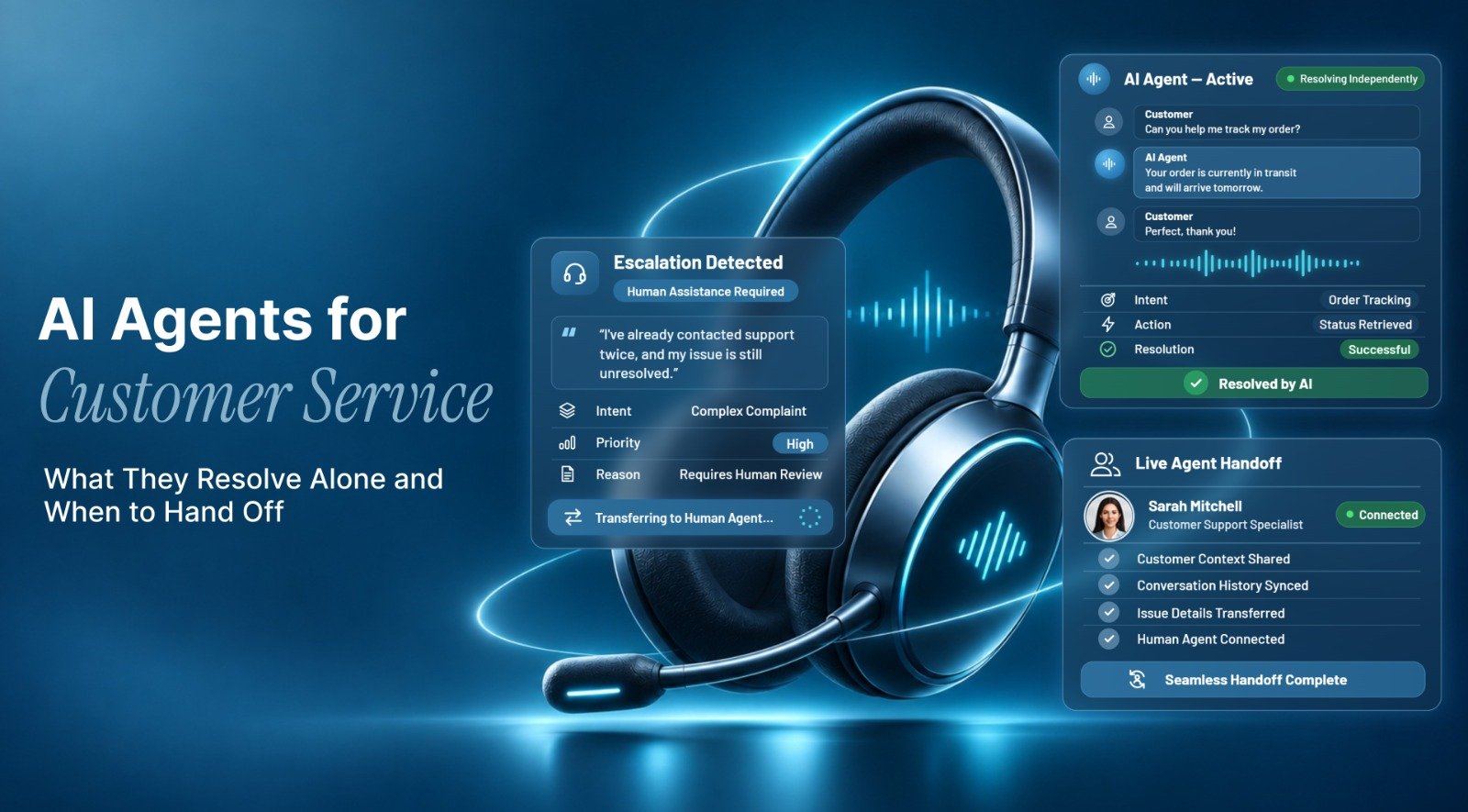
Most customer questions aren’t hard. Where’s my order? Can I move my appointment to Thursday? Do you deliver to Belgium? What are your opening hours on King’s Day? Your team answers these every day, often dozens of times.
AI agents for customer service are built for exactly this work. Connected to your systems, they can fully resolve routine, rules-based requests by chat or phone at any hour. They should not handle complaints, exceptions, emotionally charged conversations, or decisions with real consequences for the customer. Those belong with a person, and in the Netherlands regulators expect a person to stay reachable.
What Is an AI Customer Service Agent?
An AI customer service agent is software that understands a customer’s request in natural language, finds the right information, and takes action to resolve it. It can work in website chat, WhatsApp, email or on the phone.
It differs from the older chatbots many people remember in two ways.
It understands rather than matches. A classic chatbot follows a decision tree: click “Orders”, then “Track my order”. An AI agent works out what the customer means, even when they phrase it unexpectedly or ask two things at once.
It can act, not just answer. Connected to your booking system, CRM or shop platform, an AI agent can look up an order, reschedule an appointment or create a support ticket. Without those connections it is a well-spoken FAQ page.
What AI Agents Can Resolve on Their Own
Information Requests
Opening hours, prices, delivery areas, return policies, how-to questions. If the answer exists in your knowledge base and doesn’t depend on judgement, an AI agent can give it accurately and consistently. Outdated policies produce outdated answers, so keep the source current.
Transactions Inside Clear Rules
This is where AI agents save the most time:
- Booking, moving or cancelling appointments
- Order status and delivery tracking
- Returns or exchanges that meet your policy
- Updating an address or contact details
- Taking a restaurant order or a room reservation
The test is simple. If an experienced employee would handle the request the same way every time, without needing to ask a manager, an AI agent can usually complete it.
Intake and Triage
Even when an AI agent can’t solve the problem, it can do the groundwork. It collects the order number, photos, address and a description of the issue, then creates a ticket or transfers the conversation with a summary. Your team starts with context instead of starting from zero.
What Should Go to a Human
Good AI agents know their limits and hand off early. These situations need a person:
- Complaints and frustration. An angry customer wants to be heard, and a scripted apology from software usually makes things worse.
- A refund outside the return window, or a goodwill gesture for a loyal customer. These are judgement calls.
- Vulnerable situations. Bereavement, financial hardship, health worries, or a customer who is clearly confused.
- Decisions with significant consequences. Under Article 22 of the GDPR (AVG), people have the right not to be subject to decisions based solely on automated processing that produce legal or similarly significant effects, with limited exceptions. Credit, contract termination or claim rejection shouldn’t be left to an AI agent alone.
- Unclear technical faults that need diagnosis beyond a standard checklist.
- Repeated failure. If the customer has rephrased the same question twice, the agent should offer a person rather than try a third time.
The handover matters as much as the rule. A good handoff passes the full conversation and collected details to your team. A bad one tells the customer to call back during office hours.
Measuring “Resolved” Honestly
Vendors often report containment: the share of conversations that never reached a human. Containment isn’t resolution. A customer who gives up and leaves also counts as “contained”.
Track these instead:
- Resolution rate: conversations where the customer’s issue was actually solved, confirmed by a completed action or the customer’s own answer
- Repeat contact: whether the same customer comes back about the same issue within a few days
- Escalation rate and reasons: why conversations went to a person, which shows where your knowledge base has gaps
- Customer satisfaction after AI conversations, measured separately from human ones
- Transcript reviews: reading a sample every week, especially in the first months
A Useful Lesson From Klarna
Klarna’s experience shows both the potential and the risk. In February 2024 the company said its AI assistant had handled about two-thirds of customer service chats in its first month, around 2.3 million conversations. In May 2025, CEO Sebastian Siemiatkowski told Bloomberg that cost had been “too predominant” a factor, which led to lower quality. He said customers should know “there will be always a human if you want,” and that investing in human support was the way forward.
The takeaway isn’t that AI agents fail. Volume handled by AI is the wrong goal on its own. Quality of resolution and an easy route to a person decide whether customers trust it.
What the Rules Say in the Netherlands
Three points are especially relevant for Dutch businesses.
Disclose the AI. Since 2 August 2026, Article 50 of the EU AI Act requires that people are told they are interacting with an AI system, unless it is obvious from the context. A clear opening line in chat or on the phone covers this.
Keep a person within reach. In October 2025, the Autoriteit Persoonsgegevens and the ACM said jointly that chatbots must not fully replace human customer service, that people should always have the option to speak to an employee, and that bots must not give incorrect, evasive or misleading information.
Expect customers to test it. In August 2026, the Consumentenbond reported that nearly 90% of the more than 10,000 panel members it surveyed felt chatbots make it harder to reach a real employee. An AI agent that hides the exit will feed that frustration.
How to Roll Out an AI Agent in Five Steps
- List your top contact reasons. Use ticket tags or call notes to find the 10 to 15 questions that make up most of your volume.
- Sort them into three groups: resolve fully, collect and hand off, or always human.
- Prepare the knowledge base and connections. Up-to-date policies, plus access to the calendar, CRM or shop system for the tasks you want automated.
- Write the escalation rules first. Define triggers such as keywords, sentiment, repeated questions and topics, and decide where each handover goes during and outside office hours.
- Launch narrow, then expand. Start with one channel or a handful of request types, review transcripts weekly, and widen the scope as resolution rates hold up.
Conclusion
AI agents for customer service resolve routine questions and rule-based tasks well, around the clock, as long as they are connected to your systems and fed accurate information. They should hand off complaints, exceptions, vulnerable customers and consequential decisions to people, with the full context. Measure real resolution rather than containment. In the Netherlands, disclose the AI and keep a human easy to reach. That is both a regulatory expectation and what customers ask for.
To see where the line sits in practice, explore Voxion’s customer support demo, which answers common questions and escalates only when a person is needed, or compare the chat and voice agents.